
A Pharmacists Guide to Blood Pressure Drugs 2025
Why we Treat High Blood Pressure?
Every cell of the body needs a good supply of blood to:
- remove carbon dioxide and waste matter
- bring food and oxygen to allow the cell to live
When blood pressure is high, not only can the blood flow be slightly reduced, but because of the way cholesterol gathers on the inside of your arteries, it can also make your blood flow erratic. This altered flow means that cells are not consistently washed and fed. Over time, this can age the cell and lead to organ damage.
Reducing your BP to a normal range allows blood to flow more evenly through your body and protects cells and organs from ageing and damage. Benefits of keeping your BP in a healthy range include lower the risk of stroke, heart damage (heart failure, heart attack etc.) and kidney damage. It also protects skin, connective tissue (including skin) and brain health.
What Is Normal Blood Pressure?
For people under 80 years of age, the target BP is 140/90 mmHg.
However, if you are at risk or have a history of cardiovascular disease or diabetes, your BP will need to be kept a bit lower. The target here is 130/80 mmHg.
At What Level do we Treat Hypertension?
Medics generally start drug treatment when your BP reaches 160/100 mmHg persistently. At this stage, it may cause damage (often in the long term) to your body.
We have gone into more detail on what causes high blood pressure and why we treat it in our blog What is High Blood Pressure & Why is it Bad?
How to Lower Blood Pressure without Drugs
Reducing your blood pressure through lifestyle is possible. While many people do remain on long term hypertension medicines, it is possible to use them as a bridge while lifestyle changes take effect. If you wish to manage your blood pressure through lifestyle, please consult your doctor to reduce your medicines gradually. Lifestyle changes required to reduce Hypertension involve:
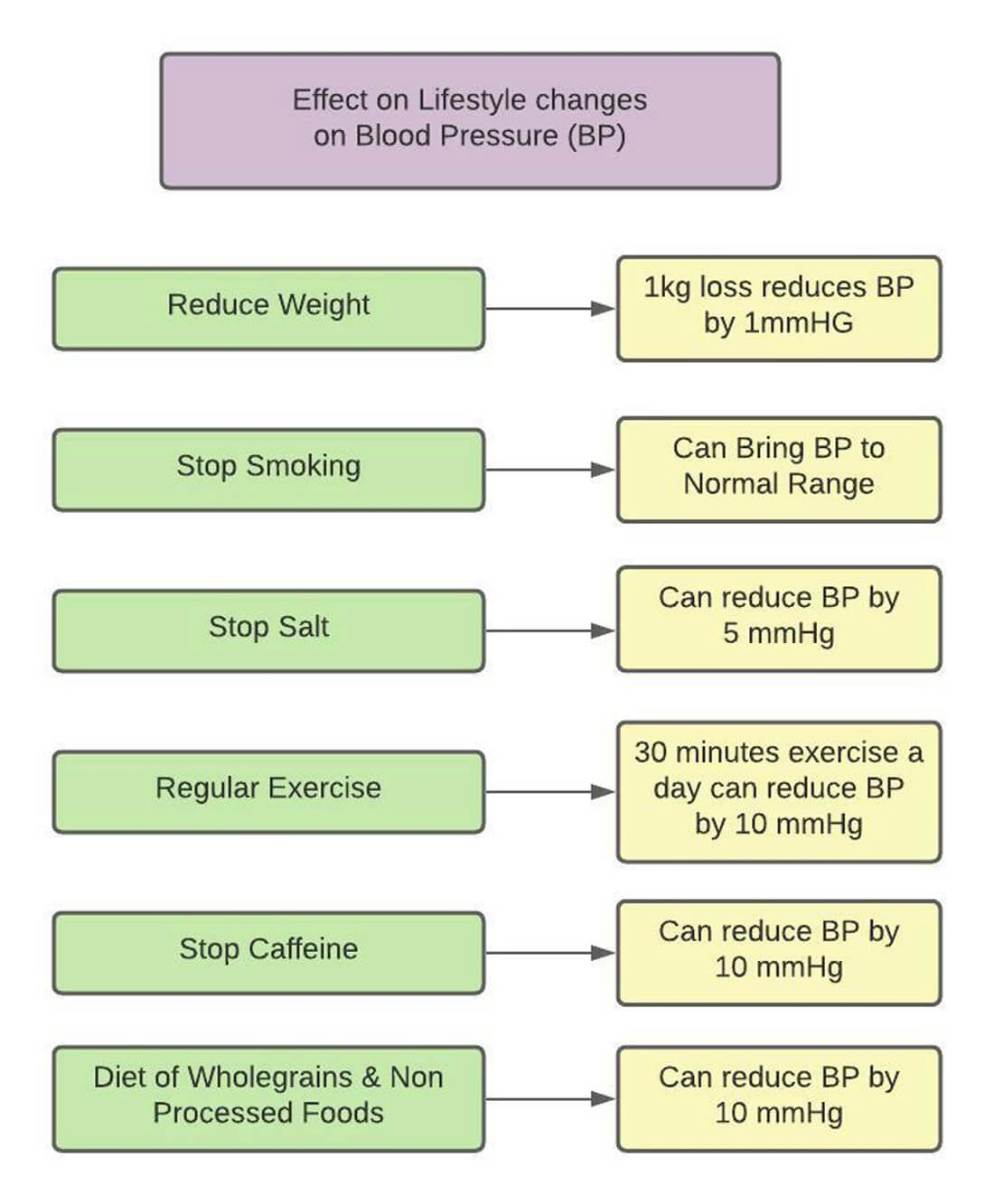
- Stop smoking. Nicotine (in cigarettes) acts on receptors to immediately raise your blood pressure. Stopping smoking instantly reduces BP (i.e. in as little as 20 minutes), and many people find one day after quitting, their BP has normalised.
- Reduce your weight if your BMI is over 25. If you are overweight, this is one of the most effective ways of reducing BP. Each kg you lose will generally reduce your pressure by 1 mmHg. Carrying weight around your waistline has the most significant effect on BP. Women should target a waist of 35 inches or less and men a waist of 40 inches.
- Take regular exercise. Taking about 150 minutes of exercise a week can reduce BP by almost 10 mmHg. Ideal activities include walking, jogging, swimming or cycling.
- Minimise salt, alcohol and caffeine intake. Eating a diet full of whole grains and fresh vegetables with low fat can reduce BP by up to 10 mmHg. Similarly, reducing your intake of sodium or alcohol can lower blood pressure by up to 5 mmHg. Cutting out caffeine can reduce BP by up to 10 mmHg.
- Minimise stress levels. As emotions cause most of our lifestyle issues, attacking emotional problems can lead to long term lifestyle changes. Practical methods to reduce stress include keeping a gratitude journal, doing healthy activities you enjoy, avoiding stress triggers and balancing emotions. My favourite technique to reduce stress is the Breakthrough Method by Dr DeMartini, but others find meditation or counselling useful.
The chart below summarises how to reduce blood pressure by lifestyle methods. Herbal medicines can also be of great use in reducing your BP. You may find our blog called Supplements to Reduce Blood Pressure of use.
How does a Doctor Choose Medicine for Me?
A doctor will look at several things before deciding which medicine to give you. These include:
- If you have diabetes
- Your age
- Your ethnic background (Different medicines work better for different genetics)
While there is a range of medicines used to treat hypertension, the following are the main groups:
- Ace Inhibitors and ACE2 Inhibitors
- Calcium channel blockers
- Beta-blockers
- Alpha-Blockers
- Diuretics
These medicines can be used alone or in combination if required. Treating resistant Hypertension may require more than one medicine. Alternatively, your doctor may wish to give you low doses of each drug to minimise side effects.
The following general guidelines are used (but not mandatory):
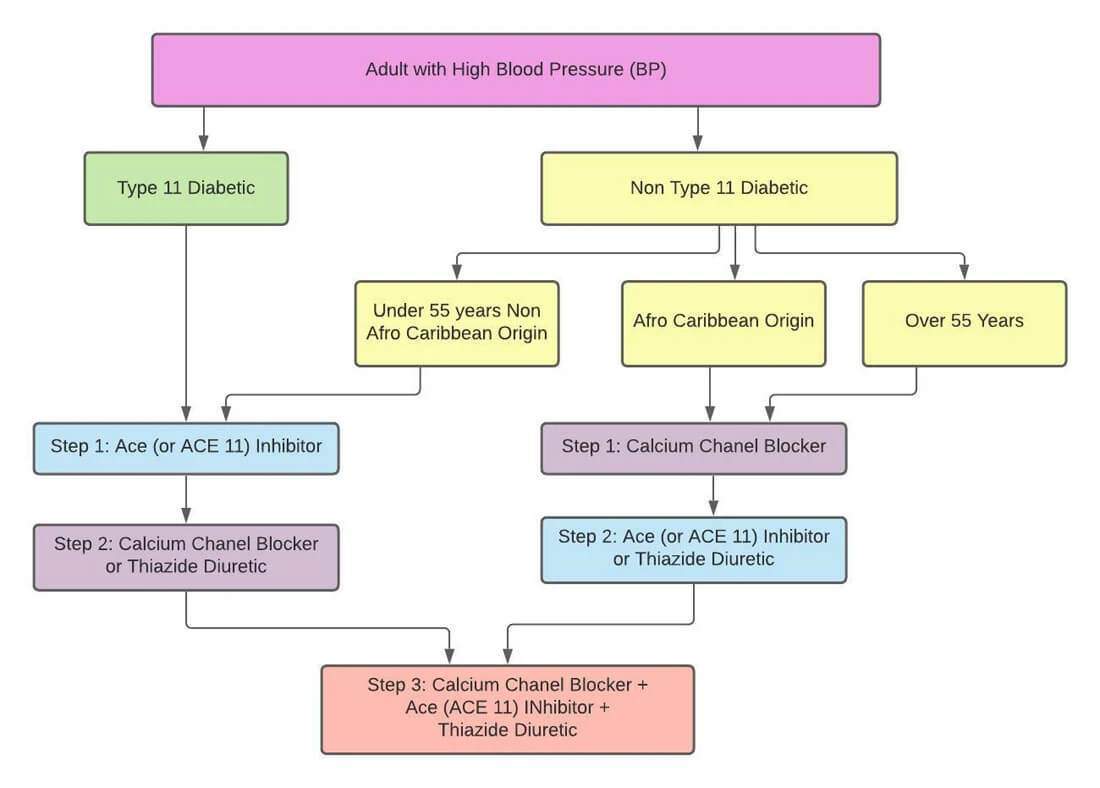
- If you have Type 2 diabetes, an ACE (or ACE11) Inhibitor will be used as step 1 & a calcium channel blocker or diuretic added as step two if required.
- If you are less than 55 years of age & not of African Caribean origin, ACE (or ACE11) Inhibitor will be used as step 1 & a calcium channel blocker or diuretic added as step two if required.
- If you are over 55 years and do not have type 2 diabetes, you will most likely be started on a calcium channel blocker and have an ACE (or ACE11) inhibitor added as a second-line medicine.
- If do not have Type 2 Diabetes and are of African Caribean origin a calcium channel blocker will be used in step one, and an ACE (or ACE11) inhibitor or diuretic added as a second-line medicine.
The chart below illustrates which drug you will be given to treat high Blood Pressure.
Examples of Blood Pressure Medicines & Brands
Ace Inhibitors
- captopril (Capoten),
- enalapril (innovace)
- fosinopril
- lisinopril (Zestril),
- perindopril (Coversyl),
- quinapril (Accupril),
- ramipril (Tritace), and
- trandolapril (Gopten).
ACE II
- Losartan (Cozaar)
- Telmisartan (Micardis)
- Irbesartan (Co approvel)
- Candesartan (Atacand)
- Olmesartan (Omescar / Konverge)
- Valsartan (Diovan)
Calcium Channel Blockers
- Amlodipine (Istin)
- Diltiazem (Dilzem )
- Felodipine (Plendil®)
- Nifedipine XL (Adalat XL®)
- Verapamil
Beta-Blockers
- acebutolol (Sectral)
- atenolol (Tenormin)
- bisoprolol fumarate (Emcor)
- carvedilol
- esmolol
- labetalol (Trandate )
- metoprolol
- nadolol
- nebivolol
- propranolol (Hemangeol, Inderal LA, Inderal XL, InnoPran XL)
- sotalol (Sotacor)
Alpha Blockers
- Alfuzosin
- Doxazosin (Cardura)
- Prazosin (Minipress)
- Silodosin
- Tamsulosin (Flomax)
- Terazosin (Hytrin)
Diuretics (Thiazides)
- Chlorothiazide
- Chlorthalidone.
- Hydrochlorothiazide
- Indapamide.
- Metolazone.
Ann O’Flynn B.Pharm, MA, BSc, MPSI
Ann is the owner of dPharmacy and has a particular interest in Health foods and supplements. Ann is a Tutor pharmacist and has gained numerous qualifications in alternative therapies - which she uses alongside her extensive clinical training. If you have any queries on medicines or health foods please reach out to us by email, text or phone.
 Chat online >>
 Call us on >>
 Email us at [email protected] >>
Disclaimer
Please be aware that the information on our site is for information only. While we hope you find it helpful, it is not our intention for our articles to be used as a basis for diagnosis or treatment. If you suspect you may have a health issue or wish to start taking any medicine, please consult your pharmacist, doctor or contact us directly. You can get in touch with us by phone, email, online chat or text. We would be delighted to run through any concerns you may have. Our goal is to deliver health directly to you - pleasantly and effectively. However, dPharmacy will not accept responsibility for any side effects or health damages from the use of medicines offered on this site.